Top 10 Scientific Advances of 2016 in China
The Ministry of Science and Technology (MOST) announced China’s top 10 scientific advances in 2016 on February 20, 2017. Sponsored by the High-Tech Research and Development Center of MOST, the top 10 selection has been successfully held for 12 sessions. The aim is to boost publicity of China's major scientific advances in basic research, motivate science and technology workers, popularize knowledge about fundamental science, enable the public to better understand, value and support basic research, and create a sound social climate for science. The scope of the 2016 selection included 278 research advances recommended by the editorial departments of 5 journals: China Basic Science, Science and Technology Review, Bulletin of Chinese Academy of Sciences, Bulletin of National Natural Science Foundation of China, and Chinese Science Bulletin. The whole process consisted of 3 phases, i.e. recommendation, primary selection and final selection. Ten projects were finally selected and announced as the ten most important scientific advances of China in 2016. Details are shown in the following passages.
1. New Cobalt-based Catalyst for Efficient CO2 Electroreduction to Liquid Fuel
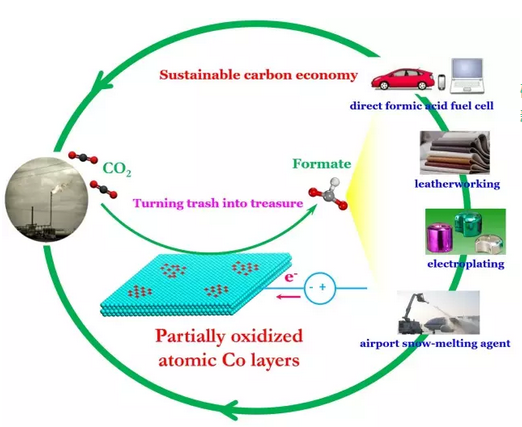
The project team led by Xie Yi and Sun Yongfu of the University of Science and Technology of China (USTC) fabricated two kinds of four-atom-thick layers: pure cobalt metal, and co-existing domains of cobalt metal and cobalt oxide to assess the roles of metal and metal oxide in two different catalytic sites. They found that surface cobalt atoms of the atomically thin layers have higher intrinsic activity and selectivity towards formate production, at lower over potentials, than do
surface cobalt atoms on bulk samples. Partial oxidation of the atomic layers further increases their intrinsic activity, realizes stable current densities of about 10 milliamperes per square centimetre over 40 hours, with approximately 90 per cent formate selectivity at an overpotential of only 0.24 volts, which outperforms previously reported metal or metal oxide electrodes evaluated under comparable conditions. The research helps researchers rethink how to obtain highly efficient and stable catalysts for CO2 electroreduction. The paper has been published by Nature (Nature [529(7584):68-71]) on January 7, 2016. As Professor Karthish Manthiram, a chemical engineer from California Institute of Technology (CIT) comments: “It is a breakthrough in fundamental sciences. Though there’s still a long way to go before commercial use, it provides positive insights from every aspect for the future.”
2. New Shortcut for Olefins Production from Coal
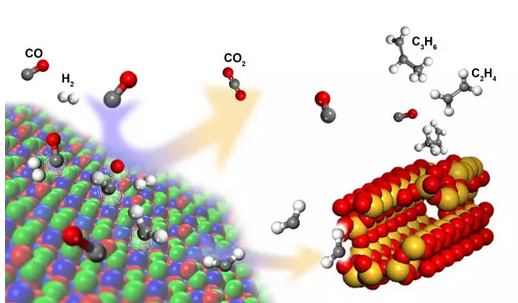
Based on the basic principle of nano-catalysts, the project team led by Bao Xin and Pan Xiulian from the Dalian Institute of Chemical Physics under the Chinese Academy of Sciences (CAS), developed a composite catalyst which contained an oxide (ZnCrOx) that exhibits a typical spinel structure and a mesoporous SAPO zeolite (MSAPO) exhibiting CHA structure with a hierarchical pore texture. They successfully realized the efficient one-step olefins production from coal-derived syngas. They presented a process whose selectivity of C2 to C4 hydrocarbons reaches as high as 80%, breaking the limit of the Fischer-Tropsch synthesis. At the same time, the reaction process has completely avoided the presence of water molecules. The process separates CO activation and C−C coupling onto two different types of active sites with complementary properties at the nanoscale. The partially reduced oxide surface (ZnCrOx) activates CO and H2, and C−C coupling is subsequently manipulated within the confined acidic pores of zeolites. Thus CO conversion is manipulated via the surface structure of the oxides and the ratio of oxides/zeolite, whereas the olefin selectivity is controlled by the properties of zeolites, particularly the pore structure and acidity. The paper has been published by Science (Science [351 (6277): 351-1068]) on March 4, 2016 and commended by an article titled Surprised by Selectivity published under the column Perspectives in the same issue. These theoretical breakthroughs are expected to create substantial industrial competitiveness.
3. The molecular inheritance mechanism of heterosis for yield traits in rice
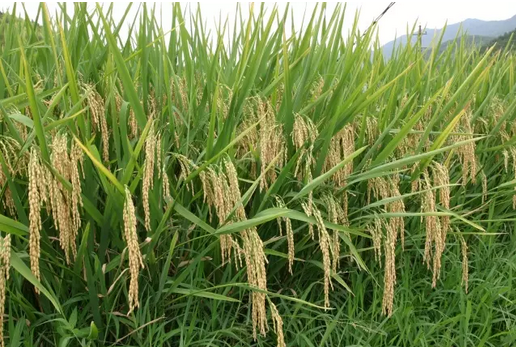
Han Bin’s and Huang Xuehui’s group, Institute of Plant Physiology and Ecology, Shanghai Institutes for Biological Sciences, CAS, in cooperation with Yang Shihua’s group, China National Rice Research Institute, analyzed the data of genomics and phenomics of 10,074 F2 lines from 17 representative hybrid rice crosses. They thus systematically identified the genomic loci related to the heterosis of rice yield. They classified modern hybrid rice varieties into three groups, each representing different hybrid breeding systems. Although no heterosis-associated loci shared across all lines are found, within each group, a small number of genomic loci from female parents, through incomplete dominance, contribute largely to the yield advantage of hybrids. This result facilitates effective hybrid combination for high-yield, quality and resistant hybrids. The research was published on Nature on 29th, September, 2016 (Nature, 537, 629–633)
4. A new way of cancer immunotherapy based on modulating cholesterol metabolism
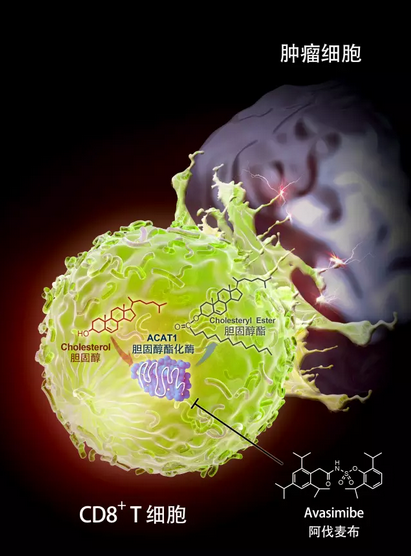
Xu Chenqi, Li Boliang and their collegues from Institute of Biochemistry and Cell Biology, Shanghai Institutes for Biological Sciences, investigated T-cell tumor immune-response from a new perspective. The researchers held that modulating the “metabolic checkpoint” of T-cells can change their metabolism and can make T-cells more ‘metabolically fit’ to fight against tumor cells. The researchers found that ACAT1, a cholesterol esterification enzyme, is the metabolic checkpoint for tumor immune-response and that inhibiting ACAT1 can potentiate the anti-tumor activity of the CD8+T cells. The research opens a new field of cancer immune therapy and proves the key role of metabolic modulation. The research also identifies ACAT1 as a new drug target and broadens the application of the small molecule inhibitor of ACAT1. The research offers new ideas and methodologies for cancer immunotherapy. The research was published on Nature (Nature, [531 (7596): 651-655]) on 31st, March, 2016. Nature’s peer review points out that the result of this research could be developed into new antitumor and antiviral drugs. Cell’s peer review holds that this research offers new hope to patients who are immune or resistant to anti-PD-1 therapy.
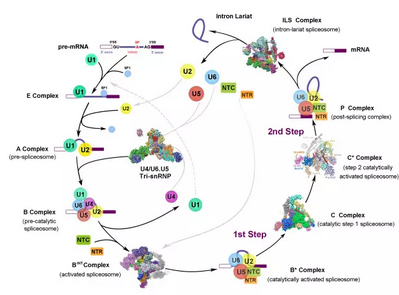
5. Key molecule mechanism for RNA splicing
Shi Yigong’s Lab, School of Life Sciences, Tsinghua University, acquired samples of good properties from yeast endogenous proteins. Utilizing single-particle cryo-EM, the researchers reported the near-atomic resolution structure of 3 activated spliceosomes and the high-resolution structure of 1 key complex during spliceosome assembly. These 4 findings were published on Science in 2016 (Science 351:466-475;353:895-904;353:904-911;aak9979). The spliceosome state of these 4 high-resolution structures covers key catalytic steps of RNA splicing, explaining at the molecular level the mechanism that spliceosomes carry out RNA splicing. The research greatly promotes the basic research on RNA splicing.
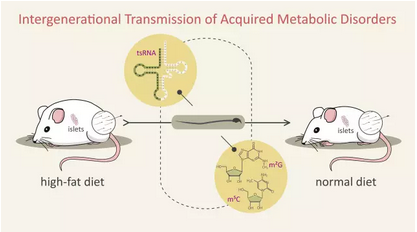
6. Sperm RNAs contribute to intergenerational inheritance of an acquired trait
Zhou Qi and Duan Enkui group, Institute of Zoology, CAS, in cooperation with Zhai Qiwei, research fellow with Institute for Nutritional Sciences, CAS, used a mouse model given a high-fat diet (HFD) and found that a subset of sperm transfer RNA-derived small RNAs (tsRNAs), mainly from 5' transfer RNA halves and ranging in size from 30 to 34 nucleotides, exhibited changes in expression profiles and RNA modifications. Injection of sperm tsRNA fractions from HFD males into normal zygotes generated metabolic disorders in the F1 offspring and altered gene expression of metabolic pathways in early embryos and islets of F1 offspring. The research offers, for the first time, a new perspective of sperm tsRNA in studying the intergenerational inheritance of acquired traits. The research holds that sperm tsRNAs represent a paternal epigenetic factor that may mediate intergenerational inheritance of acquired diseases. The research was published on Science on 22nd, January, 2016 (Science [351 (6271): 397-400]). The article was widely quoted and commented, drawing the attention of various international media.
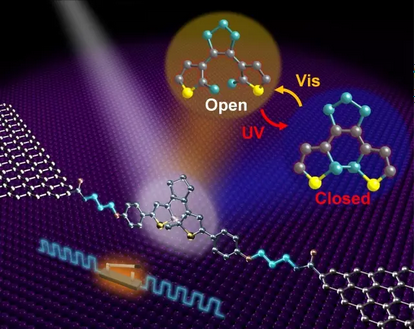
7. First stable and controllable single-molecule electronic switching device
Guo Xuefeng’s group, Beijing National Laboratory for Molecular Sciences, Peking University, finds out how to fabricate stable, covalently bonded, single molecule devices with graphene as electrodes. The researchers solve the problem that single molecule devices are hard to fabricate and have poor stability. They also cooperate with Xu Hongqi’s group with the Department of Electronics, Peking University and Abraham Nitzan, University of Pennsylvania. The joint research was function- oriented and based on molecular engineering. The research addressed the core challenge that strong coupling effect exists between diarylethene molecule and graphene electrodes. The research led to a new type of fully reversible, two mode (photo- and electric field- induced) single molecule optoelectronic devices. The research makes China the first in the world to fabricate real, stable and controllable single molecule electronic switches. Graphene electrodes, the stable carbon structure of diarylethene molecules and the strong covalent molecule/electrode bond gives these single molecule switches unprecedented accuracy, stability and reproducibility. These switches enjoy a broad prospect of application in highly-integrated information processors, molecular computers, precise molecular diagnostics etc. The research article was published on Science on 17th, June, 2016 (Science [352(6292):1443-1445]). The Perspective article on the same issue held that the research showed precise control on materials at the Nano level.
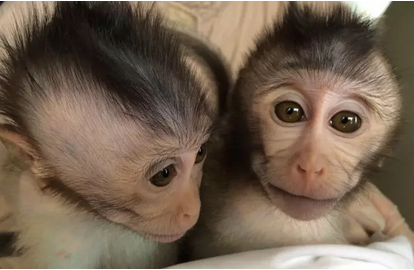
8. World's first autism model of non-human primates
Qiu Zilong’s group, Institute of Neuroscience, Shanghai Institutes for Biological Sciences, CAS cooperated with Sun Qiang’s team of non-human primates’ research platform of the same Institute. The researchers constructed a model of transgenic monkeys overexpressing MECP2 (human autism-related gene) and undertook molecular-genetic and behavioral analyses for these transgenic monkeys. They found that the monkeys showed autism-like repetitive behaviors and defects in social interaction. The researchers are the first to accelerate the monkeys’ reproduction using testicular transplantation. In 3 and a half years the researchers got the second-generation MECP2 transgenic monkeys and found these offspring exhibit the same autism-like phenotypes. The study established the first non-human primate model for autism and contributes greatly to exploring the pathology of and possible treatment and intervention for autism. The research paper was published on Nature on 4th, February 2016 (Nature [530(7588):98-102])
9. The epigenetic mechanism to regulate key signaling pathways in embryonic development
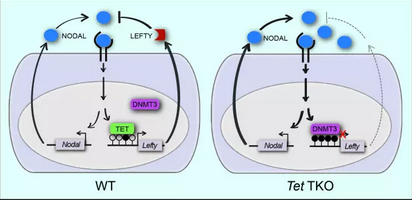
Xu Guoliang’s group, Institute of Biochemistry and Cell Biology, Shanghai Institutes for Biological Sciences, CAS cooperated with Sun Xin, University of Wisconsin-Madison and Tang Fuchou, Peking University. They generated mouse embryos deficient in TET3 using germline-specific conditional knockout parents. Through morphological and gene function analyses, they explained the mechanism that inactivation of TET genes leads to embryo failure. They found that TET genes coordinate to modulate Lefty-Nodal signaling and thus gastrulation by promoting mediated demethylation in opposition to DNMT-mediated methylation. The research starts with the major issue of developmental biology and focuses on possible pathology, prevention and treatment of birth defects. The research reveals for the first time the epigenetic mechanism regulating key signaling pathways during embryo development and offers a new perspective in understanding the basic principles of developmental biology. The research paper was published on Nature on 27th, October, 2016. (Nature [538:528-532]).
10. Nuclear quantum effect of water
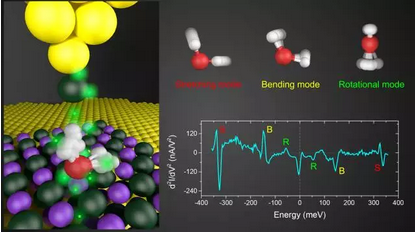
Wang Enge and Jiang Ying’s group, School of Physics, Peking University, along with their colleagues, have made breakthroughs both in experimental techniques and theoretical methodologies. They explored the tip-enhanced inelastic electron tunneling spectroscopy (IETS) and acquired the high-resolution vibration spectrum for a single water molecule. Based on that, the researchers found out the strength of a single H-bond. The researchers carried out ab initio path integral molecular dynamics (PIMD) simulations and precisely described the quantum state of electrons and nuclei. The researchers led the world in finding the quantum component of H-bonds and revealed for the first time the nuclear quantum effect of water at the atomic level. It was showed that the quantum component of H-bond contributes much more to the bond strength than the thermal energy even at room temperature and the an-harmonic zero-point motion of hydro-nuclei would weaken the weak bonds and strengthen the strong ones. This is widely applicable to various H-bonded systems. The research answers quantitatively for the first time the basic question in material science about the quantum component of H-bonds and clarifies the quantum nature of H-bonds, an issue having been debated for a long time in academia. The research helps us understand many abnormal properties of water and other H-bonded systems. The research paper was published on Science on 15th, April, 2016 (Science [352(6283):321-325]). Peer review holds that this research is an outstanding piece of experiment for the research on the hydro-nuclei quantum effect. Prof. Dominik Marx from Germany, respected expert in NQE research, believes that this research accomplishes unbelievable tasks.
(Source: Science and Technology Daily 21st, February, 2017)