MOST Holds Press Conference on S&T Development
On February 16th 2017, MOST held a press conference attended by Director General (DG) He Defang from the Department of Policies, Regulation and Supervision, Xu Jing, DG from Department of Innovation and Development, Zhang Xiaoyuan, DG of Department of Resource Allocation and Management, and Ye Dongbai, DG of Department of International Cooperation. They respectively briefed on China’s S&T policies, regional innovation, science financing and management of central budget for S&T development, as well as international S&T cooperation.
S&T Policies
First, facilitate S&T system reform in a comprehensive, systemic and coordinated manner. In
the Action Plan of Furthering the S&T System Reform issued in August 2015, a timetable and roadmap were formulated to accomplish 143 tasks and take 32 measures in 10 aspects in 2020. The reform has expanded from scientific research to cover economic and social areas, shifted the focus from R&D management to innovative services, benefited not only the scientists and engineers but also the general public. The reform is becoming increasingly complex, influential and down-to-earth, serving as an important part of facilitating the reform in a comprehensive manner. Till now, 58%, or 83 of the proposed tasks in the Action Plan have been accomplished; initial progress has been made in 60 tasks and about two thirds of the tasks have been completed.
Second, breakthroughs have been made in STI policies. With regard to universally favorable policie of improving corporate incentives for innovation, policies have
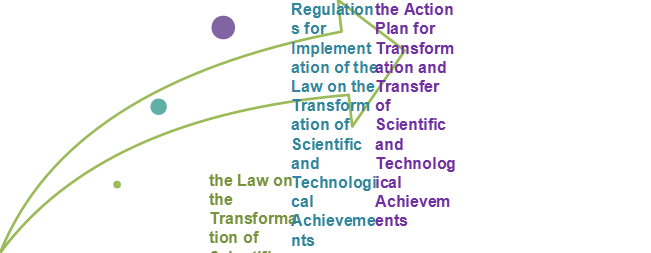
been formulated and refined in enterprises’ R&D expenditure deduction, tax preference of hi-tech companies, and accelerated depreciation of R&D equipment, so as to relieve the burden and add to the incentives for enterprises. In 2015, 53,600 enterprises enjoyed deduction treatment, with 75.9 billion yuan of tax deducted, an increase of about 6 times compared with 2008. According to a survey, 97.5% of the enterprises increased their input in R&D after enjoying the favorable policy. In terms of translation of research findings, a series of laws and regulations have been promulgated, including the Law on the Transformation of Scientific and Technological Achievements, Regulations for Implementation of the Law on the Transformation of Scientific and Technological Achievements and the Action Plan for Transformation and Transfer of Scientific and Technological Achievements. Relevant departments and localities have issued a series of supporting policy documents in terms of complete delegation of the power to use, disposal and earnings of S&T achievements, cancellation of approval and recording and the complete ownership of research benefits; the share of bonus for researchers have been greatly increased; tax preference has been given to the stock ownership incentive of researchers; researchers assuming leading positions have become entitled to the benefits from research finding translation; an impunity mechanism for leaders in pricing has been introduced.
Third, facilitate team building. Under the leadership of the Central Coordinating Group on the Work of Talents, MOST is accomplishing the mission of cultivating and introducing entrepreneurial figures under the One Thousand Talents Program and the Ten Thousand Talents Program, providing important platforms for development of scientists and engineers. When it comes to the One Thousand Talents Program, MOST is responsible for the application and approval of national key innovation bases, key labs and entrepreneurial talent platforms. There were 5,208 talents in the first 12 batches of experts under the One Thousand Talents Program, among which 4,577 were innovative and entrepreneurial talents. In terms of the Ten Thousand Talents Program, over 1,200 experts have been recommended by MOST since its inception in 2012. Since 2012 when the Innovative Talent Introduction Program was introduced, 1,081 young and middle-aged leading scientists and engineers, 733 innovative and entrepreneurial talents, 255 innovative teams in key areas and 123 demonstration bases for innovative talent cultivation have been confirmed in the first 4 phases.
Regional Innovation
Regions are the foundation and pillars of national innovative development. In line with the overall deployment of the CPC and the State Council, MOST has made progress in the effort to build an innovative country by comprehensive facilitation, reform and incentives and basic guarantee.
MOST worked with relevant departments to facilitate the building of scientific and entrepreneurial centers in Beijing and Shanghai in the following areas:
First, optimize the layout of basic research bases and boost original innovation;
Second, implement a batch of major S&T programs and engineering projects and lay a solid foundation for industrial innovation;
Third, promote development of various innovation players and improve the overall efficiency of STI development;
Fourth, further reform on S&T system and improve the ecosystem of innovation and entrepreneurship.
At present, the blueprint for the two scientific and entrepreneurial centers has been drawn. The building of the comprehensive national science centers in Huairou, Beijing and Zhangjiang, Shanghai have been accelerated, the mega-science facilities like the user device of super-strong and super-short laser and experiments under comprehensive extreme conditions have been launched, and the implementation of strategic S&T programs and engineering projects concerning aero-engines and gas turbines, bio-medicine and high-end chips have been accelerated.
Building an innovative country requires the involvement of provinces as the major players, the coordination of innovative development among big, medium and small cities, and a sound multi-level national pattern. Since 2013, MOST has pushed forward the pilot work of the innovative provinces in Jiangsu, Anhui, Zhejiang and Shaanxi, offering support in the capacity of pooling innovation resources, comprehensive strengths and industrial competitiveness, environment for innovation and entrepreneurship, innovation-based social development for livelihood, policy system and governance structure. The R&D input of the four provinces accounted for 25.7% of the national total, hi-tech enterprises 28.3%, industrial added value of high technologies 29.2%. Last year, MOST furthered the pilot work of innovative provinces in Hubei, Guangdong and Fujian, encouraging them to play a leading role in regional innovative development. Moreover, MOST worked with NDRC in supporting the pilot work in 61 cities including Hefei and Shenzhen. Last year, a guidance on building innovative cities was issued, helping set up regional innovation highlands at city level. In 2015, the 61 cities became home to 58,146 hi-tech enterprises, 76.7% of national total; the main business income of hi-tech industry amounted to 9.12 trillion yuan, 65.1% of national total.
Respecting the reforming, exploring and pioneering spirit at the grass-root level is the key to great achievement in innovative development. MOST worked with relevant sides in comprehensive pilot innovation reforms in Beijing, Tianjin, Hebei, Shanghai, Guangdong, Anhui, Sichuan, Wuhan, Xi’an and Shenyang. Efforts have been made in exploring effective mechanisms for giving play to the role of market and government, efficient approaches for integrating S&T with economy, measures in arousing the initiatives of innovators and models in furthering
open innovation. According to surveys and evaluations, the implementation of 169 measures have been quickened in areas like IP protection, border entry management for talents, transformation of S&T achievements, civil-military integration, incentives for innovation and entrepreneurship, research budget management and financial innovation.
The national innovation survey system is the institutional arrangement of monitoring and evaluating national innovation capacity based on scientific and standardized statistical survey on major innovation players like enterprises, research institutes and colleges. It is of great significance to analyzing the process of building an innovative country and comparing our innovation development with other countries. Since 2012, MOST has worked with relevant departments in the statistical survey of innovative activities by enterprises, colleges and research institutes, and issued monitoring and evaluation reports of innovation capacity for the country, regions and national hi-tech zones, offering important references for decision-making of regional innovative development and the building of an innovative country. According to statistics, our innovation capacity jumped to the 18th place in the world. It is estimated that in 2016 the contribution rate of science and technology will stand at 56.2%; R&D expenditure 1.554 trillion yuan, 2.18 times that of the level in 2010, and the R&D personnel FTE 3.81 million, an increase of 49.2% compared with 2010, ranking the second and the first respectively; the number of SCI science papers reached 290,000, doubled compared with 2010, ranking second in the world; the application and authorization of domestic invention patents ranked No.1 and No.2 respectively in the world.
Science financing
In terms of reform for managing S&T budget, three important documents have been issued, namely the No.434 document jointly released by Ministry of Finance (MOF) and MOST in 2011, the No.11 document released by the State Council in 2014, and the No. 50 document jointly released by the General Office of the CPC Central Committee and the General Office of the State Council in 2016. The three documents serve as the institutional framework for managing the central budget of S&T projects, giving seven rights to research institutes and researchers.
First, independent adjustment of project budget. The right to budget adjustment for S&T projects was given to research institutes that will approve the projects themselves.
Second, independent decision on the proportion of the service charge.
Third, independent arrangement of the performance-based award for the personnel. The research institutes will decide what portion of the indirect costs could be used as the performance-based award.
Fourth, independent allocation of the excessive project surplus.
Fifth, independent decision on the standard of travel and meeting expenses.
Sixth, independent use of horizontal fund.
Seventh, independent translation of research project funds.
The science community generally believed that the promulgation of the afore-mentioned documents has relatively solved the major problems in the use of research funding. National institutions have made reasonable arrangement, while the next priority is the implementation of the policies, which is decided by research institutes themselves. Those institutes will formulate their own implementation details in line with relevant regulations and their research strengths, provide references for auditing departments and fund monitoring agencies, and check their own management behaviors and capacity.
MOST has made some arrangement in guiding private capital for STI activities and major R&D missions oriented to national goals. First, support enterprises in increasing R&D input for greater innovation capacity through universally beneficial tax preference policies like tax deduction. Second, support enterprises in shouldering national major R&D missions and arouse the initiatives of both public and private sectors. Central budget is oriented to national goals, while relevant enterprises are also expected to fund for joint projects. Third, central budget has established a fund of funds for new business investment, encourage social capital and financial institutions to enter innovation areas, especially activities of research finding translation. MOST is now managing the National Fund for Technology Transfer and Commercialization. Up till now, 9 sub-funds have been set up, with a total volume of about 20 billion yuan.
MOST is embarking on some new missions.
First, MOF and MOST will soon launch loan risk compensation, which is an important function of the National Fund for Technology Transfer and Commercialization. In line with the cooperation agreements with banking institutions, central finance will offer a certain portion of risk compensation when providing loans to tech-based SMEs. Meanwhile, collaborative activities with local governments will be funded by both central finance and local authorities.
Second, the People’s Bank of China, China Banking Regulatory Commission and MOST will jointly initiate pilot projects of coordination between investment and loaning, which is also an important breakthrough for the management system of banking institutions. The banking industry has not been allowed to conduct mixed operation, namely financial institutions were forbidden to offer loans and invest in real business. However, the national innovation demonstration zones have been chosen as the pilot areas, where pilot banks would be allowed to conduct mixed operation. In other words, efforts will be made to integrate the financial tools of loaning for innovative enterprises and investing in translation of research findings.
Third, explore how to introduce social capital into R&D activities besides the transformation of S&T achievements. A win-win model for joint funding needs to be established, so that social capital can support national major R&D missions and share national innovation achievements. National major R&D missions are often innovative research activities which are unknown and uncertain and subject to the risk of failure. Therefore, relevant institutions of risk compensation need to be studied, which will attract more social capital. At present, we are negotiating with private enterprises, listed companies, SOEs and SASAC. It is expected that when it comes to national major R&D activities and major strategic layout, central budget and more social capital could be involved to bear risks and share benefits.
Last but not least, the exploration and promotion of PPP model. This model could be used for mobilizing private capital for joint development in independent innovation demonstration zones, national hi-tech zones and comprehensive experimental zones for sustainable development.
International Cooperation
In recent years with the growth of globalization and China’s economic strength, science and technology (S&T) has played an increasingly important role in China’s relation with the rest of the world. Countries around the globe have been expecting more from China’s innovation. For China itself, it is also imperative to engage with the international network of innovation and make full use of domestic and international resources. On the one hand, efforts should be made to promote national economic growth and serve the overall diplomatic interest. On the other hand, it is necessary to play a bigger role internationally and shoulder the due responsibilities as a major country.
According to a UNESCO report released in November 2015, China has become an important global R&D center. From 2007 to 2013, the share of China’s R&D spending in the global total rose from 14% to 20%, the share of internationally published S&T papers increased from 9.9% to 20.2%. In both rankings China is now second in the world.
The 2016 Global Innovation Index (GII), released on August 15 of 2016 and jointly drafted by the World Intellectual Property Organization (WIPO) and other relevant institutions, shows that for the first time China is among the world's 25 most innovative economies, the first and only middle-income country in the top 25.
While engaging in international cooperation in science, technology and innovation (STI), China has firmly grasped opportunities derived from changes in the global political, economic and innovation landscape. For China, international STI cooperation has played a key role in three aspects. First, it supports the China’s overall diplomacy, helps forge new relations with major countries, promotes practical cooperation with other developing countries, and enables China to have its voice heard and make bigger impacts on multilateral occasions. Second, it provides China with access to international mega-science projects, tackles bottleneck issues in the development of science, technology and industry, and facilitates leapfrogging developments in related fields. Third, through mechanisms such as innovation dialogues, China and its foreign partners can boost mutual trust, dispel doubts, and thus creates a friendly international environment for China’s economic restructuring and upgrade.
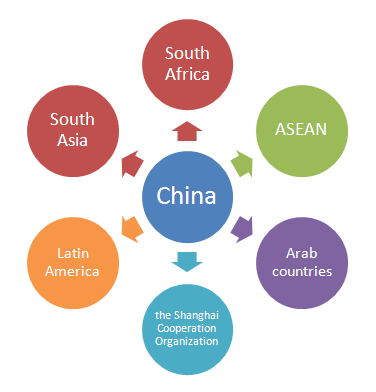
At present, China has science and technology cooperation with 158 partners including countries, regions and international organizations. It has signed a total of 111 inter-governmental agreements on S&T cooperation and acceded to over 200 inter-governmental S&T organizations. Globally there are 146 Chinese science diplomats in 71 overseas Chinese missions. China has also launched eight mechanisms of innovation dialogue with the world's major countries and regions (namely the United States, the European Union, Germany, France, Israel, Brazil, Russia and Canada). For developing countries, China has set up six major S&T partnership programs (with South Africa, ASEAN, South Asia, the Shanghai Cooperation Organization, Latin America, and Arab countries), and has built extensive connections with developing countries on a global scale.
In September 2016, for the first time the G20 Summit held in Hangzhou highlights "innovation" as a key topic. The Chinese Ministry of Science and Technology (MOST) spearheaded the innovation taskforce and the drafting of the G20 Innovation Action Plan which was incorporated in the G20 Leaders’ Communique and the G20 Blueprint on Innovative Growth. In November 2016, MOST took the lead in hosting the first G20 Science, Technology and Innovation Ministers Meeting which issued the Statement of the G20 Science, Technology and Innovation Ministers Meeting. The meeting served as a pioneer in efforts to follow up on the outcomes of the G20 Summit, and spread far and wide the message of "innovation is the primary driving force for development, and science and technology are the core of innovation". In September 2016, MOST teamed up with other three ministries in the release of the Plan on STI Cooperation to Promote the Belt and Road Initiative. In December, it launched Key Projects on International STI Cooperation under the National Key R&D Program.
Looking into the future, we will continue to move forward with the concept of open innovation for mutual benefits and win-win outcomes, actively engage in STI cooperation across the globe, and take an active stance in contributing new ideas, new initiatives and new solutions in the international arena. We will fully leverage our role as a frontrunner and catalyst in the international cooperation on production capacity and equipment manufacturing, with an aim to open up new horizons for the “invite in” and “go global” pursuit of China.
In 2016, MOST issued the Shaping the Future through Science, Technology and Innovation, Strategies for China-Germany Cooperation. This year we are working on similar country-specific strategies on cooperation with the UK, Italy, and Israel among other countries. We are also planning for major initiatives on building cooperation platforms, promoting key technology R&D, diffusing research achievements, advancing innovation clusters, and developing partnerships on youth innovation and entrepreneurship.
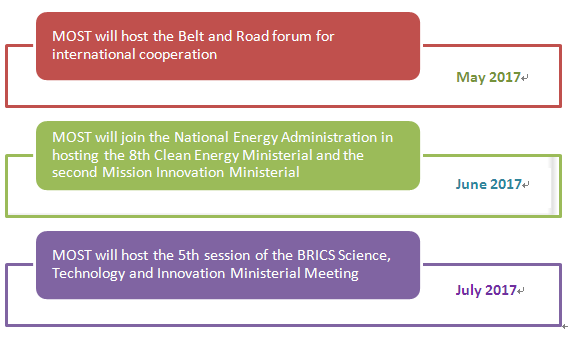
In June this year, MOST will join the National Energy Administration in hosting the 8th Clean Energy Ministerial and the second Mission Innovation Ministerial. Energy ministers from nearly 30 countries and ministerial-ranking officials from six international organizations are expected to attend. These events aim to effectively guide common actions on clean energy and play a more important role in the global response to climate change. In late July this year, MOST will host the 5th session of the BRICS Science, Technology and Innovation Ministerial Meeting to effectively promote STI cooperation between and among BRICS countries.
As for the STI cooperation in the Belt and Road Initiative, we are preparing for a specific action plan which will be released this year when appropriate. At the same time, STI cooperation will be presented as an important content of the Belt and Road forum for international cooperation to be held in May.
To act on the requirement of the 5th Plenary Session of 18th CPC Central Committee which explicitly underlines China’s potential for playing a leading role in the organization of international mega-science programs and engineering projects, this year we are mobilizing all relevant resources to study on and formulate plans for action.
In addition, in 2004 the Chinese mainland and Hong Kong set up a joint committee on science and technology cooperation to carry out a series of joint efforts and further enhance innovation capability. Last September, with the support of MOST, the Our Hong Kong Foundation successfully held the InnoTech Expo 2016 in Hong Kong and hit a historic high of 100,000 person-times of visitors. In the next step, we will give full play to the STI advantages of both Hong Kong and the mainland, and develop Hong Kong’s own STI platform so as to expedite local developments, enhance economic vitality, and give full play to the role of Hong Kong as a super-connector between the Chinese mainland and the rest of the world.
(Source: Ministry of Science and Technology, February 16, 2016)